The toy aisle contains two fundamentally different categories of toys, and confusing them has profound consequences for child development. One entertains; the other develops. One is designed for parental convenience; the other for child learning. Understanding this distinction enables parents to make strategic choices that accelerate development rather than shortcut it.
The Core Difference: Who Controls the Play?
The fundamental distinction between entertainment toys and developmental toys is not complexity, price, or technology. It’s who directs the play experience.
Entertainment Toys (Passive Toys)
The toy is in control. The child watches as the toy flashes lights, plays predetermined sounds, executes programmed movements. The toy “does the play” for the child. The child’s role is to activate it (press button) and observe the result.
Examples:
- Electronic toy that plays ABC song when button pressed
- Battery-operated toy that moves across the floor automatically
- Toy that recites colors when you press the color buttons
- App-based toy that displays predetermined animations
Developmental Toys (Active Toys)
The child is in control. The toy is simple and responds only to the child’s manipulation. The child decides what happens, what it becomes, how to use it.
Examples:
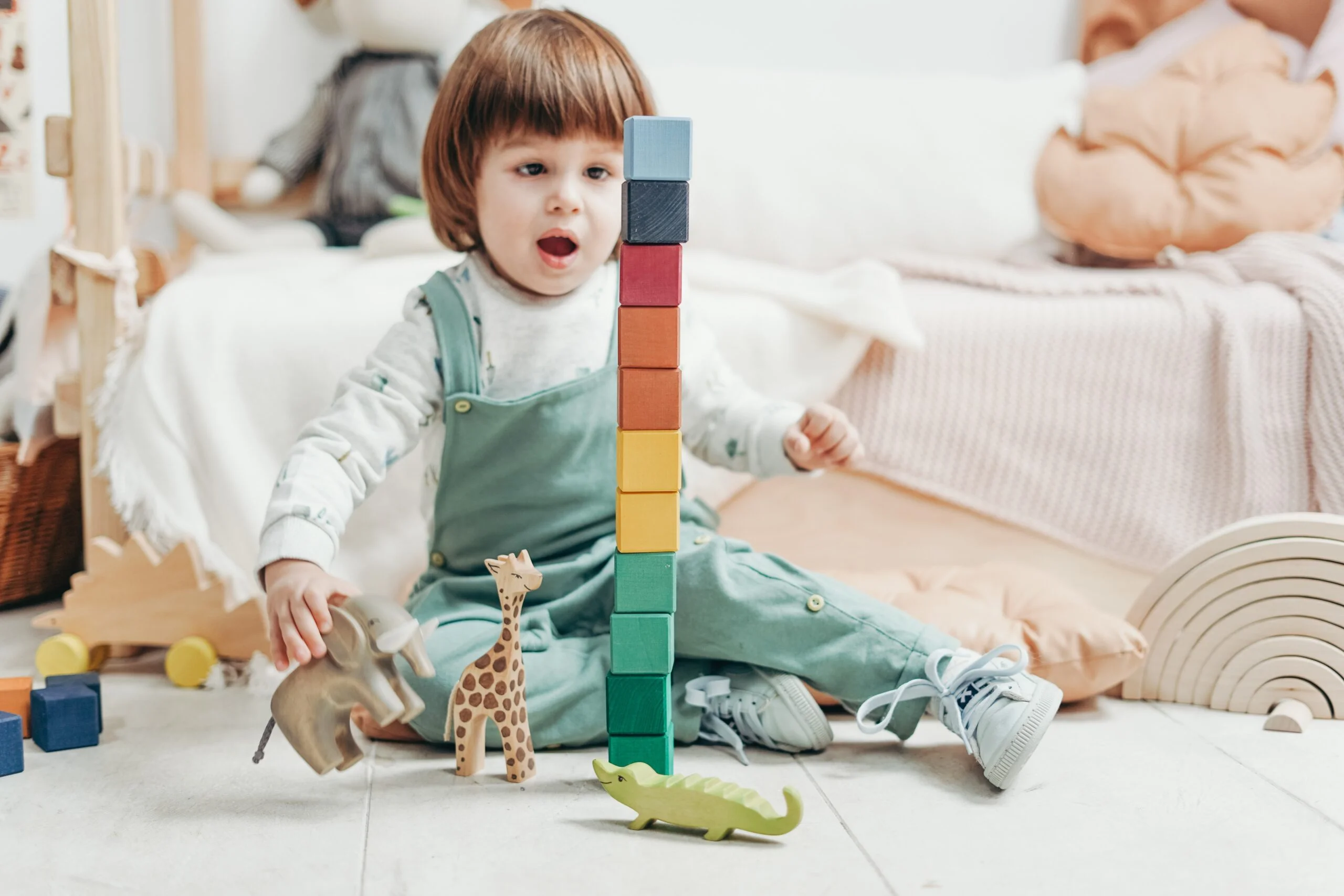
- Wooden blocks (child decides what to build)
- Dolls (child creates all scenarios and dialogue)
- Balls (child decides games and uses)
- Art supplies (child directs all creation)
- Open-ended dramatic play props (kitchen items, doctor sets—child directs all scenarios)
This apparently simple distinction masks profound neurological and developmental differences that compound over years.
How They Differ: Six Critical Dimensions
Dimension 1: Cognitive Demand
Entertainment Toys Require Minimal Thinking
The cognitive pattern is simple: press button → observe result. Once the button is discovered, cognitive demand ends. These toys present “task-defined problems” where the correct answer is built into the toy’s design—you find it through trial-and-error of pressing buttons.
Example: Toy that “teaches colors” plays a sound when you press color buttons. Cognitive work: identify which button, press it, hear result. The learning is toy-defined, not child-invented.
Developmental Toys Demand Maximum Thinking
The cognitive pattern is complex and evolving. The child must constantly invent: “What can I build? How should I use this? What story am I creating? What problem did I encounter and how do I solve it?” These toys present “child-defined problems” where the child invents both the problem and solution.
Example: Blocks. Cognitive work: envision a structure, plan how to build it, manage physics (what falls, what balances), adapt when plans don’t work, invent something new when completed. The learning is child-invented.
Research Finding: Children using divergent thinking toys (open-ended, child-directed) show significantly greater creativity and problem-solving capacity than those using convergent thinking toys (predetermined, single-solution).
Dimension 2: Creative Possibility
Entertainment Toys Have Single, Locked Purposes
Once the toy’s feature is discovered, the creative possibilities end. The toy can only be used as designed. A toy designed to “teach numbers” recites numbers—it doesn’t become a house phone, a pretend microphone, a musical instrument, or anything else the child imagines.
Creative limitation: Toy dictates use; child complies.
Developmental Toys Have Infinite Creative Possibilities
A single block becomes: tower, bridge, phone, food, imaginary friend, road, wall, vehicle—whatever the child’s moment-to-moment imagination creates. The toy doesn’t constrain possibility; it liberates it.
Creative liberation: Child dictates use; toy adapts.
Impact: Research shows children with fewer open-ended toys demonstrated 52% more creative play variations compared to children with many predetermined toys.
Dimension 3: Engagement Duration and Pattern
Research reveals counterintuitive findings about engagement:
Entertainment Toys: Initial Engagement, Rapid Abandonment
- High initial interest (“Wow, lights and sounds!”)
- Rapid novelty wear-off (limited features to explore; once explored, nothing new happens)
- Abandonment point (toy gets boring; child moves to next toy)
- Average play duration: 5-15 minutes
The toy’s features are exhausted quickly. Once a child has pressed all buttons and seen all light patterns, there’s no reason to return.
Developmental Toys: Sustained Engagement, Deepening Over Time
- Variable initial interest (a block isn’t flashy, so may take moments to engage child)
- Indefinite novelty (child keeps finding new uses; novelty never exhausts)
- Sustained engagement (child returns repeatedly because each play session differs)
- Developmental sophistication (as child’s skills develop, toy supports increasingly complex play)
- Average play duration: 20-40+ minutes
The toy’s possibilities are inexhaustible because the child generates them.
Landmark Research: A University of Toledo study observed 36 toddlers aged 18-30 months in free play. When children had access to 4 toys, they engaged in 63% longer play periods and used toys in 52% more varied and imaginative ways compared to sessions with 16 toys.
This finding challenges conventional parenting wisdom: more toys don’t mean longer engagement; they create fragmentation and reduced quality.
Dimension 4: Motor Skill Development
Entertainment Toys: Limited, Repetitive Motor Patterns
- Typically fine motor only (button pressing, screen swiping)
- Gross motor development minimal
- Same repetitive motions produce same results (pressing button X always makes sound Y)
- No novelty in motor challenge after initial exploration
- Child learns “how to activate toy,” not how to move skillfully
Motor limitation: Repetition without progression.
Developmental Toys: Complex, Varied Motor Development
- Fine motor: Precise manipulation (placement, threading, grasping)
- Gross motor: Large movement (reaching, bending, balancing, climbing)
- Varied patterns: Different ways to use toy create different motor demands
- Progressive challenge: As skill improves, child attempts greater complexity (stacking higher, reaching farther)
- Real-world application: Movements develop actual physical competencies
Motor progression: Challenge that develops with child’s capacity.
Example: Building blocks develop fine motor (precise placement), gross motor (bending, reaching), balance (stacking without falling), spatial awareness (understanding height and width), and planning (sequencing).
Dimension 5: Language Development
Research on language development reveals a critical difference:
Entertainment Toys: Reduced Language Exposure
- One-directional communication: Toy talks AT child (“This is the color red”)
- Reduced parental narration: Toy provides the description (less need for parent to explain)
- Limited vocabulary exposure: Toy vocabulary is fixed and limited
- Passive language input: Child receives information rather than generating it
- Minimal dialogue: Little back-and-forth conversation
Research Finding: Children using electronic toys show “reduction in both the amount and quality of language exposure when compared to interactions with books or conventional toys.”
Developmental Toys: Rich Language Exposure
- Bidirectional communication: Parent and child discuss play together
- High parental narration: Parent describes what child is doing, asks questions, extends thinking (“You’re building a tower! What will happen if we add another block?”)
- Vocabulary expansion: Rich descriptions across varied scenarios
- Active language production: Child narrates their own play, creates dialogue for dolls, describes scenarios
- Ongoing dialogue: Constant back-and-forth conversation during play
Research Finding: Co-play with simple toys yields significantly more language input and higher-quality language exposure than passive observation of electronic toy features.
Critical Impact: Language development in early childhood predicts later academic success, social skills, and even executive function. The toy type has measurable consequences for language trajectory.
Dimension 6: Emotional and Social Development
Entertainment Toys: Limited Emotional Processing
- Predetermined emotional tone (happy, silly, aggressive)
- Limited opportunity to explore feelings safely
- Character is fixed, limiting role-play exploration
- Social scenarios limited to toy’s design
- Emotional processing passive (observe toy, don’t create scenarios)
Developmental Toys: Rich Emotional Processing
- Emotional exploration: Child uses dramatic play to explore feelings safely (doll acts out emotional scenarios; child processes)
- Role flexibility: Same toy becomes different characters, allowing exploration of varied perspectives
- Scenario control: Child directs scenarios, controlling emotional intensity
- Peer interaction: Open-ended toys invite cooperative play and peer negotiation (building together, pretending together)
- Empathy development: Caring for dolls, negotiating with peers, creating character perspectives
Research Finding: Pretend play with open-ended toys significantly predicts executive function and emotional regulation development. Children with high levels of pretend play showed greater emotional control and better inhibitory control two years later.
The Neurological Reality: “Passive Toys Build Active Minds”
Research reveals a paradoxical principle that contradicts intuition:
“Passive toys (that need YOU to make them work) build active minds and bodies! Busy toys (with flashing lights and noise) create passive observers.”
This seems counterintuitive: the toy that DOES more creates a PASSIVE child. The toy that DOES nothing creates an ACTIVE child. Yet the neuroscience explains why:
When a toy provides entertainment, the child can simply observe. Over time, the child’s brain adapts to passive reception of stimulation. When a toy requires child activation, the child must engage brain networks for problem-solving, creativity, and planning. Over time, the child’s brain adapts to active generation of experience.
The Neural Consequence: Children habituated to passive entertainment toys may develop reduced ability for self-directed play and independent thinking. Conversely, children engaged with simple toys develop robust independent play capacity and creative problem-solving.
This becomes evident in play patterns: a child who always had electronic toys often struggles with unstructured free play, needing external entertainment. A child who grew up with simple toys naturally generates play scenarios independently.
Engagement That Surprises: Why Simplicity Sustains Interest
One of the most counterintuitive research findings is why simple toys sustain engagement longer than complex, feature-laden toys:
The Four Reasons Simple Toys Engage Longer:
1. Infinite Possibility vs. Finite Features
A battery toy’s features can be exhausted (press all buttons, see all light patterns). A block’s possibilities can never be exhausted (new structures, new scenarios, new stories infinitely possible). Novelty drives engagement; novelty in simple toys is inexhaustible because child-generated.
2. Skill-Responsive vs. Skill-Fixed
Simple toys grow with the child’s skill. A 1-year-old stacks 3 blocks; a 3-year-old builds elaborate structures. The toy presents ongoing challenge because difficulty level responds to developing skill. Electronic toys remain the same regardless of skill development—they can’t adapt.
3. Imagination-Powered vs. Toy-Powered
In simple toys, the child generates the stimulation (imagining stories, inventing uses). In electronic toys, the toy generates stimulation (lights, sounds). Child-generated stimulation can be infinite; toy-generated stimulation is finite.
4. Frustration-Free vs. Frustration-Prone
Blocks can’t “break” or fail. If a structure falls, rebuild differently. Electronic toys can fail (batteries die, buttons break, sounds glitch), leading to frustration and abandonment. Simple toys sustain engagement because they’re frustration-resistant.
Research Validation: The landmark study found toddlers with 4 toys played 63% longer than those with 16 toys, with 52% more creative variations. The difference wasn’t toy quality—it was the management of attention and possibility.
The Sensory Overwhelm Factor
A practical but often-overlooked consequence of entertainment toys is sensory overwhelm:
How Entertainment Toys Create Overwhelm:
- Multiple toys playing simultaneously = competing sensory input
- Flashing lights + sounds + movements = overstimulation
- Unpredictable activation (child presses button; result happens) = sensory surprises constantly
- Visual chaos in toy-filled rooms = difficulty focusing attention
- Cumulative noise level rising throughout play
Consequence: Research shows sensory overwhelm reduces focus, increases frustration, and impairs concentration.
How Developmental Toys Support Sensory Order:
- Quiet environment supports concentration
- Single toy focus possible (other toys out of sight)
- Child-controlled sensory input (child touches when ready, makes sounds through action)
- Visual simplicity supports attention
- Sensory input is responsive to child’s actions (cause-effect they control)
Neurological Impact: Calm sensory environment supports attention development. Overwhelming sensory environment trains the brain to expect constant stimulation and struggle with focus.
The Pretend Play Advantage
A critical developmental advantage of simple toys is their support for robust pretend play—and pretend play is extraordinarily powerful for development.
Research Finding: Children engaged in high-level pretend play were significantly more likely to display greater executive functions and better inhibitory control two years later.
Why does pretend play matter so much?
Executive Function Development Through Pretend Play:
- Planning: “What will happen in our story?” requires planning
- Working memory: Remembering the storyline and character roles requires memory
- Inhibitory control: Following self-created rules (our doll is shy, so she won’t run) requires impulse control
- Cognitive flexibility: Adapting story when plans change requires flexibility
Simple toys enable rich pretend play. Electronic toys often constrain it. A doll becomes “shy” or “brave” based on the child’s imagination. A character toy already IS a specific character, reducing imaginative reimagining.
Research Finding: Trendy, character-specific toys reduced children’s autonomy in creating play stories compared to simple, generic figures.
The Important Nuance: Not All Electronic Toys Are Problematic
Research reveals important nuance. Not all battery-operated or technology-based toys are developmentally problematic:
Problematic: Toys designed for passive entertainment where the toy does the playing and child observes (sounds without interaction, movements without child input).
Can Be Developmentally Sound: Toys that:
- Require active child input: Musical instrument keyboards, interactive puzzle where child input produces correct answers
- Provide feedback for child action: Child presses button; consequence happens (not automatic)
- Support specific learning through active engagement: Educational apps where child actively problem-solves
- Are co-played with adult engagement: Parent and child use technology together, discussing and extending learning
The Key Question: Does the child activate the toy? Or does the toy activate the child?
What Happens to Children Over Time: The Long-Term Impact
Research tracing long-term developmental outcomes reveals the consequences of toy choice:
Children Raised Primarily with Entertainment Toys:
- Reduced ability for independent, self-directed play
- Lower creativity and divergent thinking capacity
- Preference for external stimulation over internal imagination
- Potentially reduced executive function development
- May struggle with unstructured free play
- Higher novelty-seeking (constant need for new stimulation)
Children Raised Primarily with Developmental Toys:
- Strong independent play capacity
- High creativity and divergent thinking
- Comfort with internal imagination and self-direction
- Robust executive function development
- Skillful at unstructured free play
- Can sustain engagement with simple materials
This divergence compounds over years. A 5-year-old trained on simple toys can entertain themselves for hours independently. A 5-year-old trained on electronic toys may struggle without external entertainment.
The Practical Reality: Why Parents Choose Entertainment Toys
Understanding why parents select entertainment toys is important. It’s usually not ignorance; it’s practical constraints:
Why Entertainment Toys Appeal to Parents:
- Immediate peace: Electronic toys occupy child attention quickly, giving parent uninterrupted time
- Parental convenience: Toy entertains child without requiring parent engagement
- Visual appeal: Flashing toys catch parent attention in stores
- Grandparent gifts: Often electronic, showy toys
- Age confusion: Parents assume “educational” label means developmentally beneficial
The Trade-off Parents Face: Immediate parental relief (toy entertains child alone) vs. long-term child development (child learns independence through simple toy play).
Neither choice is “wrong,” but informed parents understand the trade-off.
The Evidence-Based Recommendation
Based on comprehensive research, the evidence-based approach to toy selection emphasizes:
Prioritize Developmental Toys (child-directed, open-ended, simple):
- Blocks and construction materials
- Dolls and pretend play props
- Balls and movement toys
- Art supplies
- Dramatic play sets (kitchen, doctor, etc.)
- Books
- Simple sensory materials
Use Entertainment Toys Sparingly (if at all):
- If used, choose those requiring child input rather than passive observation
- Co-play (parent and child together) multiplies any developmental value
- Limit quantity to avoid sensory overwhelm
- Monitor screen time and app-based toys carefully
- Remember they can’t replace simple toys for developmental impact
Create Intentional Play Spaces:
- Fewer toys total (rotation systems work well)
- Visual calm (not toy-cluttered)
- Accessible materials inviting independent play
- Space for parent-child co-play with simple toys
The Bottom Line: Play Type Matters More Than You Think
The difference between entertainment toys and developmental toys isn’t academic. It shapes how children think, problem-solve, create, and develop independence. Over years, these small choices compound into measurably different developmental trajectories.
A child playing with simple blocks for an hour develops different neural networks than a child watching lights flash on a toy for an hour. Repeated across childhood, these experiences create different brains—different capacities for creativity, problem-solving, independence, and sustained attention.
The good news: developmental toys are often simpler and less expensive than entertainment toys. The challenge: they require more parental engagement. But that engagement—narrating play, asking questions, playing alongside the child—is itself a critical developmental ingredient that entertainment toys replace with electronics.