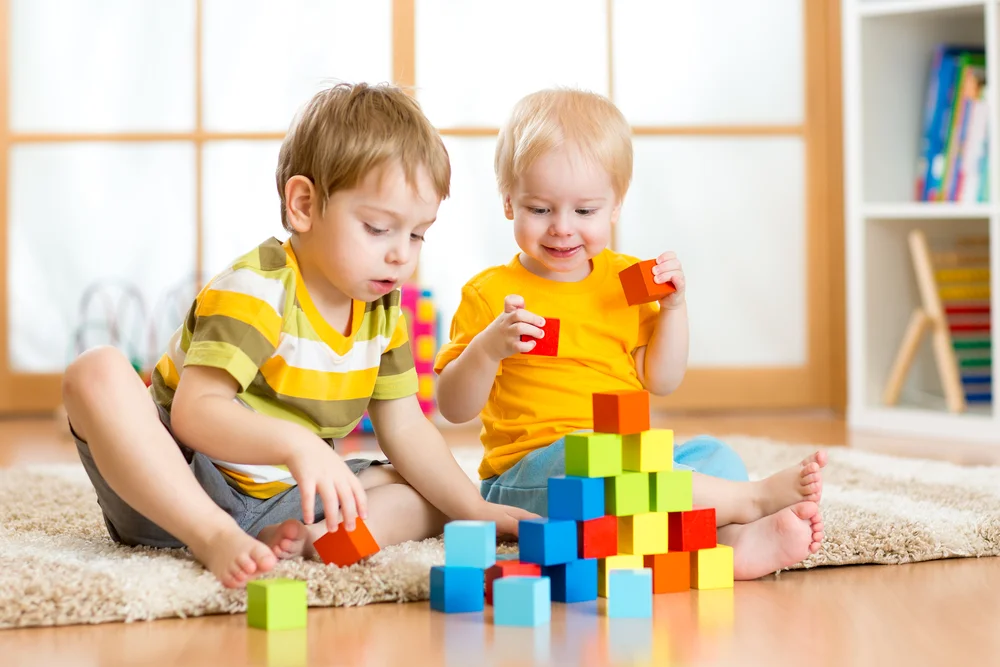
Play is not random activity that randomly improves with age. Rather, it is a systematic progression where each stage builds directly upon the previous one, creating an integrated developmental architecture. Understanding this evolution reveals something profound: what looks like simple baby movements in the first months are foundational building blocks for the complex cooperative games a 4-year-old plays with peers. From tummy time to toddler play, development follows a coherent, predictable path.
The Two Theoretical Foundations: How Play Changes
Two frameworks explain this progression—one cognitive, one social. Together, they illuminate the full picture of how play evolves.
Piaget’s cognitive stages describe the internal mental changes happening during play. From birth to 2 years, infants are in the sensorimotor stage—learning entirely through their senses and physical actions. They taste, feel, pound, and move to understand the world. Then, around age 2, the shift to the preoperational stage marks a profound change: children can now think symbolically. A block becomes a phone. A box becomes a car. This is not just new play content—it reflects a fundamental rewiring of how their brains work.
Parten’s social stages describe how children’s relationships during play transform. A newborn engages in unoccupied play, just discovering their own body. By 6 months, solitary play dominates—the child is fascinated by toys but completely indifferent to other children nearby. Around age 2, parallel play emerges: children play side by side, using similar toys, but not interacting. By age 3, associative play begins—genuine interest in what peers are doing, some interaction, but without shared goals. Finally, around age 4, cooperative play arrives: children want to work together toward common goals, with shared rules and coordination.
The critical insight is this: each stage doesn’t replace the previous one; each builds on it. A 3-year-old doesn’t abandon solitary play—rather, solitary play exists alongside associative play. A 4-year-old still engages in parallel play sometimes, but now can also cooperate. Development is additive, not sequential replacement.
Birth to 6 Months: Foundations of Sensory Play and Trust
What Play Looks Like
In these first months, play appears minimal to untrained eyes. The newborn makes random arm and leg movements. By 6 weeks, they might hold gaze intentionally. By 3 months, they reach toward objects. By 6 months, they transfer toys from one hand to the other.
But this is deceiving. The brain is building at stunning velocity. The reflexive grasping of the newborn’s palmar grasp reflex is the foundation for the fine motor skills that will one day allow writing. The head movements during tummy time build the neck and shoulder strength prerequisite for all future gross motor development.
Key Developmental Milestones
| Developmental Domain | 0-3 Months | 3-6 Months |
|---|---|---|
| Motor Skills | Head control in tummy time; reflexive grasping; arm/leg movements | Rolls to side; sits with support; transfers objects hand-to-hand |
| Cognitive | Sensory exploration; responding to sounds; visual tracking beginning | Beginning to understand cause-effect; finding partially hidden objects |
| Language | Coos and gurgles; responds to voices | Babbles with consonant-vowel combinations; laughs at faces |
| Social | Responds to caregiver; smiles reflexively | Social smiling; recognizing familiar faces; showing excitement |
What Baby Really Needs in Play
The most important element is caregiver responsiveness. When a baby coos and the caregiver responds, neural connections form. This “serve and return” interaction—where the infant initiates and the adult responds—is the engine of development.
Specific play needs:
- High-contrast visuals: Newborns see best at 8-12 inches and are drawn to black-and-white patterns
- Tummy time: 15-30 minutes daily on chest, lap, or floor builds foundational strength
- Face-to-face interaction: Making funny faces, blowing raspberries, counting fingers and toes
- Varied sensory input: Different textures, sounds, gentle movements
- Simple rattles: For grasping and exploring
- Singing and rhythm: Nursery rhymes with movement, lullabies
The cognitive demand at this stage is minimal. Presence and responsiveness matter far more than enrichment activities. A baby experiencing consistent, warm responsiveness is developing secure attachment—the foundation for all future play and learning.
6 to 12 Months: Cause-Effect Discovery and Motor Explosion
What Play Looks Like
This period marks an explosion. Around 6 months, something shifts: the baby begins to understand that their actions have effects. Drop a toy—it falls. Shake a rattle—it sounds. This understanding transforms play from passive reception to active experimentation.
Gross motor development accelerates dramatically. Sitting emerges around 6 months, crawling styles appear (bum shuffle, commando crawl, backward crawling) between 6-9 months, and by 12 months, many babies are standing and taking first steps.
Fine motor becomes increasingly intentional. The whole-hand palmar grasp of earlier months gives way to a “raking” grasp (using all fingers to rake objects toward the hand) around 6-8 months, then to the immature pincer grasp (thumb and forefinger together) around 9 months, then to true pincer grasp (precise thumb-and-forefinger control) by 12 months.
Key Developmental Milestones
| Developmental Domain | 6-9 Months | 9-12 Months |
|---|---|---|
| Motor Skills | Sitting independently; crawling/scooting styles; pulling to stand | Cruising furniture; standing with less support; first steps; refined pincer grasp |
| Cognitive | Object permanence strengthening; understanding toy function; problem-solving with objects | Intentional experimentation; using objects to discover properties; finding hidden objects |
| Language | Babbling with more complex sounds; responding to own name | “Mama” and “dada” to correct person; understanding simple instructions; beginning gestures |
| Social | Imitating adult actions; showing preferences for familiar people | Playing games (pat-a-cake, peek-a-boo); showing emotions; enjoying repetition |
What Baby Really Needs in Play
Cause-and-effect toys become central: Rattles, bells, crinkle toys, toys with buttons and switches that produce immediate results. The baby learns that their actions matter.
Problem-solving opportunities begin: Simple shape sorters introduce the concept that shapes fit only certain ways. Containers to fill and dump offer endless experimentation. Toys with different textures (smooth, bumpy, crinkly) invite exploration.
Gross motor equipment: Safe spaces to crawl, climb, and explore. Low furniture to pull up on. Balls for rolling and chasing.
Interactive games: Peek-a-boo variations, “Ready, steady, go” games that build anticipation, turn-taking games (rolling ball back and forth).
Language input: Narrating what the baby is doing (“You’re reaching! You grabbed the rattle!”) provides language in context. Singing repetitively (the same songs multiple times) supports both language learning and neural consolidation.
The evolutionary transition during this period is profound: the baby moves from being a passive recipient of experience to an active explorer who understands that they can influence their world. This emerging sense of agency is crucial for motivation and learning.
12 to 24 Months: Symbolic Play Emerges and Social Play Begins
What Play Looks Like
Around 18 months, something remarkable happens: symbolic play emerges. The child no longer just uses toys for their function. Now, a block becomes a phone. A cup becomes a hat. One object represents another. This is the beginning of imagination—the ability to hold a mental representation of something that isn’t physically present.
Simultaneously, language explodes. Around 12 months, the child might have 10 words. By 18 months, the explosion is evident—some children have 50-200 words by 24 months and understand 5 times more words than they can say.
Gross motor skills refine. Walking becomes stable, running emerges, climbing enthusiasm increases. Fine motor skills advance: the child can now stack blocks, fit shapes into sorters, and manipulate objects with greater control.
Socially, the child begins to notice other children. Not to play with them yet, but to notice their existence and mimic their actions.
Key Developmental Milestones
| Developmental Domain | 12-18 Months | 18-24 Months |
|---|---|---|
| Motor Skills | Walking independently; climbing; kneeling; stacking 2+ blocks | Running; jumping; climbing enthusiasm; stacking 4+ blocks; drawing scribbles |
| Cognitive | Functional use of toys; understanding toy purpose; problem-solving | Symbolic play emerging (block as phone); using objects to represent others |
| Language | 10-20 words; understanding 2-3 word instructions; responding to name | 50-200 word vocabulary; two-word phrases (“More milk,” “Mommy go”); asking simple questions |
| Social | Showing affection; preference for familiar people; playing near peers | Imitating peer actions; watching other children; beginning parallel play |
Understanding the Symbolic Play Transition
This transition deserves emphasis because it marks a fundamental cognitive shift. In the sensorimotor stage (birth-2 years), intelligence is based on direct physical experience. The child must manipulate objects to understand them. But as symbolic play emerges around 18 months, the child begins to think about objects without manipulating them. A pretend drink from an empty cup requires imagining the cup contains liquid—a purely mental act.
This capability unlocks development. Once a child can think symbolically, language becomes powerful (words symbolize objects), imaginative play becomes possible, and mental problem-solving emerges. It’s not that the child suddenly becomes smarter; rather, their brain has reorganized to enable new modes of thinking.
What Baby Really Needs in Play
Dramatic play props become essential: Dolls and stuffed animals for early pretend care; toy phones, cups, play food; toy vehicles. The child learns by pretending to use objects as adults do.
Functional play materials: Items that work—toys designed to operate as their real-world counterparts (toy kitchen items, tools). This bridges functional play and symbolic play.
Construction materials: Blocks for building and knocking down. Stacking cups and nesting toys. The child develops spatial understanding and problem-solving.
Peer play opportunities: Playgroups, parks with other children. The child doesn’t yet play together with peers but learns from watching them (onlooker play progressing to parallel play).
Language-rich environment: Narrating play, reading picture books with the child pointing to objects, singing repetitively. Adult language provides the input the child needs for the language explosion.
Sensory materials: Water play, sand, different textures. These provide continued sensory input while the child develops more sophisticated play on top of sensory foundations.
The Role of Repetition
A critical principle emerges during this period: children need to repeat activities many times to consolidate learning. The child reads the same book 20 times. Plays the same game repeatedly. Wants the same song sung over and over. This isn’t boredom or obstinacy. This is the child’s brain consolidating neural pathways. Repetition makes connections stronger and more automatic.
24 to 36 Months: Complex Imagination and Associative Play
What Play Looks Like
By age 2.5, the child’s pretend play has become sophisticated. No longer just pretending to drink from a cup, the child now engages in sequences of meaningful actions: feeding a doll, putting on its pajamas, putting it to bed. The play has a narrative structure—a beginning, middle, and end.
Simultaneously, a crucial social transition occurs around age 3: the child becomes genuinely interested in other children. Not just aware of them, but interested in what they’re doing. This is the beginning of associative play—interaction with peers without yet shared goals or coordination.
Cognitively, the child’s thinking is becoming less purely sensory-based and more mental. They can now solve problems through mental strategies—thinking about where something is hidden rather than having to search everywhere.
Key Developmental Milestones
| Developmental Domain | 24-30 Months | 30-36 Months |
|---|---|---|
| Motor Skills | Running stability improving; jumping emerging; drawing simple shapes | Hopping on one foot emerging; catching balls; climbing refined; drawing people |
| Cognitive | Complex pretend sequences; understanding cause-effect; sorting and categorizing | Symbolic play expanding; using objects in abstract ways (pillow as pizza) |
| Language | 300+ word vocabulary; two-word sentences; understanding body parts | Sentences with 2-4 words; asking “Why?” and “How?”; using past tense |
| Social | Playing near other children; watching them; copying actions | Becoming interested in other children; beginning interactive play; showing defiance |
What Baby Really Needs in Play
Elaborate dramatic play props: Play kitchen with food and dishes; doctor kit; dress-up clothes; dolls with accessories; toy vehicles and tracks. The child’s imagination drives endless scenarios if props are available.
Construction and creative materials: Various block types, 4-6 piece puzzles, art supplies (crayons, markers, paint, paper). These support cognitive development and fine motor refinement.
Gross motor equipment: Climbing structures, slides, swings, balance beams. Running and jumping space. The child’s motor skills are developing rapidly.
Language and literacy: Books with stories, predictable stories the child can “read” along with, books about emotions and social situations. Singing and movement songs. Adult narration of the child’s play.
Peer play opportunities with support: Playgroups, preschool if relevant. The child needs to practice being around peers and learning from watching them. Adult support for sharing and taking turns is still necessary.
The Associative Play Transition
This is where social development enters a new phase. The child begins to care about what other children think and do. Conflicts emerge as children begin negotiating (who gets the toy, whose turn is it). Learning to share and take turns becomes necessary—not because adults demand it, but because the child wants to play with peers, not just near them.
This is also where emotional development becomes more visible. The child can now comfort a peer who is upset, showing emerging empathy. Simultaneously, defiance and testing boundaries increase as the child explores their own autonomy.
36 to 48 Months: Cooperative Play Mastery and Complex Imagination
What Play Looks Like
By age 4, the shift is complete: genuine cooperative play emerges. The child now wants to play with other children toward shared goals. They can assign roles (“You be the doctor, I’ll be the patient”), understand simple rules, and work together.
Imaginative play reaches new heights. The child engages in extended narratives, taking on different characters, creating elaborate scenarios that may last across multiple play sessions. Emotionally, they’re developing clearer understanding of rules, fairness, and the feelings of others.
Motor skills are now refined. The child can hop, jump, catch, climb with confidence. Fine motor skills are approaching school readiness (drawing people, using scissors).
Key Developmental Milestones
| Developmental Domain | 36-42 Months | 42-48 Months |
|---|---|---|
| Motor Skills | Hopping on one foot; catching bounced ball; running refined; cutting with scissors | Better coordination; refined throwing/catching; drawing recognizable people; riding tricycle |
| Cognitive | Complex pretend scenarios; understanding cause-effect; problem-solving | Abstract symbolic use; planning multi-step scenarios; understanding relationships between ideas |
| Language | Sentences with 4+ words; asking complex questions; storytelling with sequence | Tells stories with clear beginning/middle/end; vocabulary expanding rapidly through play |
| Social | Playing with 1-2 peers cooperatively; understanding simple rules; showing empathy | Playing with 3-4 children; understanding fairness; forming friendships; cooperative teamwork |
What Baby Really Needs in Play
Sophisticated dramatic play props: Complete play kitchen and food; doctor/veterinarian kit; extensive dress-up clothes and costumes; transportation toys and tracks; dolls with realistic accessories. The child’s imagination is now the limiting factor, not the props available.
Games with rules: Simple board games with turn-taking, races, tag games. The child is now capable of understanding and following rules.
Books and literacy: Longer story books, books about emotions and social situations, books that the child can act out. Storytelling together.
Artistic and creative materials: Paint, markers, colored pencils, scissors (child-safe), paper, playdough, clay. The child is developing fine motor skills toward writing readiness.
Gross motor challenges: Balance beams, climbing structures, varied balls for different games, tricycles or bikes. Motor skills are refining toward organized activities and sports.
Peer play in groups: Preschool or school environments where the child plays with multiple peers, learning group dynamics, cooperation, and social skills at scale.
The Integrated Picture: How Domains Develop Together Through Play
The most important insight is that motor, cognitive, language, and social development don’t proceed in isolation. They are woven together by play.
Consider a concrete example:
At 9 months, the child drops a toy repeatedly. This looks like a simple motor activity—hand opening and closing. But simultaneously:
- Cognitively: The child is experimenting with gravity and cause-effect. “I let go, it falls.”
- Physically: The fine motor action of releasing and the gross motor tracking of the falling object build coordination and strength.
- Socially: If the caregiver narrates (“You dropped it! Down it goes!”), social connection deepens.
- Linguistically: Hearing language in context builds word learning.
At 24 months, the child feeds a doll while the caregiver watches:
- Cognitively: Symbolic representation (the spoon represents feeding), imitation of adult behavior, understanding of sequences
- Physically: Fine motor control of the spoon, positioning the doll
- Socially: The child is sharing the play with the caregiver; if with a peer, beginning associative play
- Linguistically: Narrating the play (“Dolly eat. Yum yum.”), learning vocabulary for actions and objects
At 36 months, the child plays doctor with a peer:
- Cognitively: Complex symbolic play, understanding roles and relationships, planning a multi-step scenario
- Physically: Gross motor movements, fine motor manipulation of props
- Socially: Cooperative play, negotiating roles, respecting the peer’s ideas, learning through interaction
- Linguistically: Dialogue, explaining roles, using language to create and coordinate the scenario
In each instance, play is simultaneously developing all domains. This integration is what makes play so powerful—it’s not a separate activity category; it’s the mechanism through which the whole child develops.
The Principle of Scaffolding: How Adults Support Play Evolution
Throughout this progression, the adult’s role is crucial, but it operates on a specific principle: scaffolding. Scaffolding means providing support that is just right—not too much (which creates dependence) and not too little (which creates frustration). As the child develops competence, the support gradually reduces.
How scaffolding works in practice:
At 6 months, the adult provides a rattle within reach. The child grasps reflexively. The adult narrates: “You grabbed the rattle! It sounds!” Over time, the adult provides less narration. The child plays with the rattle independently.
At 18 months, the adult sits nearby as the child plays house. The child pretends to cook. The adult asks, “What are you making?” extending the play. As the child’s pretend play develops, the adult becomes increasingly less central.
At 36 months, the adult facilitates peer play by setting up the environment and watching. If conflict arises, the adult helps solve it: “She wants to play too. Can she be the patient?” As the child’s social skills develop, the adult intervenes less.
This gradual release of responsibility—from adult-directed to child-directed play—is the hallmark of effective support. The child becomes progressively more autonomous while developing competence.
Critical Continuities Across the Four Years
Three principles operate throughout the entire period:
1. Each Stage Builds on the Previous
The solitary play of infancy makes parallel play possible. Parallel play creates the context for associative play. Associative play provides the foundation for cooperative play. A child cannot jump directly to cooperative play without practicing the earlier stages. The stages exist for developmental reasons.
2. Repetition Consolidates Learning
Children don’t progress by novelty; they progress by repetition. The same game played 50 times is more developmental than 50 different games played once. Repetition strengthens neural pathways, automatizes skills, and builds confidence.
3. Responsiveness and Following the Child’s Lead Matter More Than Complexity
An expensive toy without interaction is less developmental than a simple rattle with an attuned caregiver. The quality of adult engagement—responsiveness, warmth, attunement—matters more than the sophistication of materials. The child who feels seen and valued develops confidence and intrinsic motivation to learn.
Conclusion: Play as the Architecture of Development
From tummy time at two weeks to cooperative games at four years, play follows a coherent architecture. Each stage is necessary preparation for the next. Motor milestones enable new types of exploration. Cognitive development enables new forms of play. Social growth enables new forms of interaction. Language growth enables more sophisticated play scenarios.
For parents and caregivers, understanding this progression offers reassurance. The infant who seems to do “nothing but” grasp and mouth objects is building the fine motor foundation for writing. The toddler who plays alone for hours is developing the cognitive and emotional capacities for future social play. The child who repeats the same game endlessly is consolidating the neural pathways that will support more complex learning.
Play is not frivolous or optional. It is the primary mechanism through which the human brain constructs itself. By supporting play at each stage—following the child’s lead, providing appropriate materials, responding with warmth and attunement—adults are literally helping children build their brains. The progression from tummy time to toddler play is not incidental; it is the very essence of development.